Combat mechanics, weapons, armour etc.

“There is no problem in the Universe that couldn’t be solved with violence“
– Kharn, Captain of the XIIth Legion
*
Threats to humanity’s (or your own) survival are beyond measure, just as the means to answer them. In 30th Millennium combat is extremely deadly and brutal, with marvels of imperial technology giving no quarter to any foe and conquered adversaries vehemently responding in kind.
Despite many differences between weapons, tactics, battlegrounds and types of warfare, main principles of combat are universal for all combatants.
***
COMBAT
At the beginning of each combat, 3 steps are executed in following order:
- BATTLE CHECK – if any pre-combat test for Battle were made (in case of pre-planned ambush, tactical assault etc.), apply any advantages (or handicaps) gained by successful (or Complicated) combatants BEFORE the start of a fight (additional Action points, predetermined Initiative, bonuses to upcoming tests etc.), possibly altering results of steps 2 and 3.
- INITIATIVE CHECK – at the beginning of combat Initiative test is performed by each participant for TN = 20 – Speed value (+/- modifiers from gear, Talent etc.). The higher the level of Success – the higher the place in action queue. Should any characters be tied in their score, higher Initiative level decides, who goes first. If characters are still tied, Speed values are compared. Still tied? Reroll your Initiative test only for tied characters and repeat the process.
- ACTION POINTS CHECK – number of Action points a character can use during single turn of combat is determined by their Speed level (see Table B). Each character regains full amount of Actions points (unless severely wounded or otherwise hindered) at the beginning of each turn of combat. These points can be spent for offensive actions within their turn of initiative AND for defensive actions outside character’s action queue (to dodge, block, parry etc.), so when they finally get to their turn of initiative, their action queue begins with accordingly less Actions (or with none at all).
| SPEED level | Number of Actions |
| 10 | 4 |
| 9-7 | 3 |
| 6-4 | 2 |
| 3-1 | 1 |

COMBAT ACTIONS
There are a couple of Action types the combatants can spend their Action Points on during each turn of combat. Moves irrelevant from tactical point of view (shouting, quick glance over the cover, throwing down useless weapon or small piece of equipment etc.) don’t require spending an Action point for their execution. Regarding their aim and intent, Combat Actions are understood as one of the following:
- ATTACK – as blatantly obvious as it is, attacking means trying to destroy the target. Attack can be executed only during your turn of initiative. It always requires at least 1 Action point (sometimes more, depending on weapon requirements or other factors).
 Each attack consists of 3 steps (described in next section), all of which are performed simultaneously (from gameplay perspective), within the cost of Actions required for the attack (no separate points need to be spend for each step separately).
 - BLOCK – sometimes stepping aside from upcoming blow is not an option and sheer, defensive strength is the only shield between you and your doom. To block an enemy attack, you need to spend 1 Action Point and pass Destruction test, diminishing the Damage from opponent’s strike by 1 level for each 1 level of success you’ve achieved in the test.
- DODGE – lets make one thing clear before anything else: YOU CANNOT DODGE RANGED ATTACKS. Even Astartes or the most foul Eldar, insanely fast as they are, aren’t nearly as fast as any projectile. Therefore, dodging applies only to melee / unarmed attacks and only to the successful ones (if your opponent misses – there’s nothing for you to dodge).To dodge the upcoming strike, you need to spend 1 Action Point and pass Quickness test with the level of Success >/= attacker’s Precision test. If you succeed, the attack misses and you’ll start your turn of initiative with 1 less Action point to spend for your action queue. If you fail, the attack is resolved according to original results and you can’t try to dodge it again. You can, however, dodge any number of upcoming attacks, if you can and want to spent more Action points before taking the initiative in the same turn of combat.
- PARRY* – an option more difficult and risky than any other, parrying allows you to deflect opponent’s blows in the most beneficial way, throwing them off balance and rhythm, working towards seizing the initiative for yourself. This action can only be performed by a character with at least 1 level of Parrying (Secondary Skill). Parrying upcoming and foreseen attack requires spending 1 Action point and making a comparative Weapongence test first, between you and the attacker. If you win, you may then test Parrying and cancel 1 Action the opponent has left this turn for each level of Success you’ve gained. The attack is then also treated as a miss, like you’ve just dodge it, not necessarily by changing your position (if you don’t wish to do so).
- MOVEMENT – non-offensive action of placing your character in a chosen position on a battle map. You can choose to either move as a single action or to throw yourself into a sprint with all the muscle power you can master. During tactical combat, your character may move up to X squares on a battle map in a single Action, where X = character’s Speed. If you wish to move further and faster, you need to perform a Sprinting action (witch doubles your maximum movement range) and perform test of Quickness.
- OTHER – any tactically significant activities unrelated to direct attack (throwing yourself prone to the ground or trench, reloading or changing weapon, inserting or ejecting an Implant, using non-combative equipment, performing first aid, testing any other Skill, turning around in a corridor with your weapon ready to fire etc.) also require spending Action points and need to be performed during character’s initiative turn (unless logically justified, like throwing yourself away from a grande you saw flying towards you).
ATTACK STEPS
Each offensive Action (Attack) against an opponent or a target consists of 3 steps executed by attacking character in following tests:
*
1. WEAPONGENCE
Before firing or swinging a weapon at your target, you need to check if you are physically capable and skilful enough to do so, without harming everyone but the opponent. Astartes gear are unfit for regular human, yet even the most basic of frontline equipment (just as any common weapon in the world) is just as effective as its welder.
Target Number of Weapongence test is ALWAYS set by the used weapon itself (check the War-gear card for yours). It can be occasionally modified – by the GM (regarding weapon’s or character’s condition, environmental hindrances etc.), by an Implant or a Talent – yet the general rule remains the same: all weapons has their own requirements to be met by their users.
If a character fails to handle their weapon properly, consequences are up to GM to decide, based on severity of the failure (with or without Complications and situational factors). From minor ones, like loosing 1 Action point (by forgetting to unlock the safety switch or reload before firing) or getting -X to following Precision test, to major ones, like getting jammed, exploding etc.
***
2. PRECISION
After handling your gear “weapongently” you can fire / swing at the target and check, if you hit the spot, hit barely and more generally or miss entirely. TN of character’s Precision test is set by GM, modified by welded weapon, Talents, Implants etc.
Some weapons has an Edge threshold that, if reached or exceeded during test of Precision, doubles the Damage level in the 3rd step of your attack. Remember to check that before describing final results!
***
3. DAMAGE
When you finally hit your target, the havoc is wrecked upon foe’s flesh. Many factors can alter the severity of the harm done to your opponent – their ability to block, quality of an armour, physical might of your muscles etc., yet generally the damaging potential of your weapon is predefined, varying (if at all) between debilitating and outright deadly.
In both ranged and melee combat, the Damage level done by a weapon is always set by the the weapon itself (check the War-gear card for yours). If you were able to reach or surpass the weapon’s Edge in your Precision test, the Damage level is doubled.
*
In melee or unarmed combat, each level of Success in test of Destruction adds 1 level of Damage (see table A) to target of your attack.
*
In case of blocking, you subtract 1 level of Damage from your opponent’s total attack value for each level of Success in your test of Destruction.
*
Each armour has specific threshold of Damage absorption and unique resistance / weakness against particular type of ammo or weapon (check the War-gear card statistics). Always check if the Damage done to the target equals or exceeds that threshold – only then protection fails and remaining Damage level can be inflicted upon the victim.
*
When you engage in unarmed combat, you test Brawl instead of Weapongence and Precision. The Damage inflicted in that combat always = 1 Scratch + 1 Damage level for each Extra success in Brawl test (unless modified by a Talent or Augmentation), optionally increased by Destruction test.
***
WOUNDS & RECOVERY
Regular damage
| END | Scratch | Light | Severe | Deadly |
| 10 | 4 | 4 | 4 | 2 |
| 9-7 | 3 | 3 | 3 | 1 |
| 6-4 | 2 | 2 | 2 | 1 |
| 3-1 | 1 | 1 | 1 | 0 |
Each time an effect causes a character to suffer 1 level of damage, refer to the table A.
EXAMPLE
For example, a hero with Endurance = 6 after taking a sloppy left hook to their face worth only 1 level of Damage, gets a Scratch. Not a big deal, although after getting third such a hit, bitten hero receives first Light Wound, as his capacity for enduring 2 Scratches was overcome and his Damage progressed to the next level.
If our miserable hero would be afterwards kicked straight to the head in an attack = 3 levels of Damage (1 level from unarmed attack + 2 Successes in attacker’s test of Destruction), he would suffer 1 Severe wound right away, while still having 1 Light wound and 2 Scratches.
*
Each weapon causes permanent amount of Damage, however its level can be modified by different factors, Skills, Talents etc. (see “Attack Steps” section).
Each time you suffer from physical harm which inflicts level of Damage higher than Scratch, you test Rest Pain. Failure causes you to shiver, stumble, cry out, fall unconscious or even to loose your mind (in case of prolonged torture). Either way, your current action stops immediately and you skip your next turn of action (if in combat).
*
Whenever you suffer a Deadly wound or whenever you wish to introduce permanent augmentation to your body, Vitality test determines your survival. Untreated Deadly or Severe wounds also cause Vitality test in each full round of action, progressing to higher Damage level if the test is failed. Maximum number of augmentations a body can endure equals this skill level.
*
FIRE DAMAGE
There are many wonderful occasions to set yourself ablaze on numerous battlefields of the Great Crusade! Each time you (or, more likely, a foe of yours) decide to do so, you flesh or its cover suffers 2 levels of Damage each turn of being on fire (unless changed bu modifiers like special type of fuel, combustible atmosphere, highly flammable materials etc.). You also test Resist Pain each turn, with TN rising +2 for each consecutive test. Nothing short of Mark-class armour is by design resistant to fire, much less regular infantry combat suits, so play nicely.
*
POISON DAMAGE
Most of the time, you don’t even need an encounter with abominable, hostile xenos breed to die painful, toxic death on some distant, recently discovered death-world. Whatever your poison is, it kills you in one of three ways listed below:
- Mild poison – requires at least 3 levels of Success in 3 consecutive Regeneration tests, performed over the course of several turns / minutes / scenes (regarding the type and source of a poison and other environmental factors) to be resisted. Each failed tests nullifies previously gained levels of Success and raises TN of each next Regeneration test +2. It also causes the poisoned character to suffer 1 level of Damage for each failed test (alongside other optional impediments).
- Strong poison – requires at least 6 levels of Success in 3 consecutive Regeneration tests, performed over the course of several turns / minutes / scenes (regarding the type and source of a poison and other environmental factors) to be resisted. Each failed tests nullifies previously gained levels of Success and raises TN of each next Regeneration test +3. It also causes the poisoned character to suffer 1 level of Damage for each failed test (alongside other optional impediments). Third and each following failed Regeneration test causes Vitality test vs death.
- Deadly poison – requires at least 12 levels of Success in 3 consecutive Regeneration tests, performed over the course of several turns / minutes / scenes (regarding the type and source of a poison and other environmental factors) to be resisted. It also causes the poisoned character to make Vitality test vs death each turn and to suffer 1 level of Damage for each successful test (alongside other optional impediments).
***
Treatment & recovery
Unlike Superhuman’s, regular bodies cannot heal themselves in no-time without medical help and even the lightest wounds, collected over time, eventually become much more significant. In battlefield conditions some wounds can be treated without cancelling combatant out of the fight, yet more severe damage requires more than a field-medic and some handy frontline toys from first aid kit or even Mechanicus supplies. Even lighter wounds that were properly tend to, will hinder anyone but the Astartes themselves. The most dire ones (severed limbs, multiple gunshots, burns etc.) require the best equipment and skill put to use in sterile environment to help those lucky and strong enough to survive the harm done to their bodies.
Whenever you wish to downgrade your Damage level by 1 during Tactical Phase, you need to test Regeneration. For unaugmented characters, Extra Success doesn’t count for additional level of Damage healed, only for swifter, more complete recovery. Debilitating effects (unconsciousness, poisoning, mild external bleeding, hypoxia etc.) also can be shaken off after successful Regeneration test (1/turn). Damage of Severe or Deadly level are not subject of Regeneration without special treatment, implant or Talent.
*
For unaugmented characters, full recovery from Damage level higher than Scratch can be achieved only in proper med-bay or with skilled medic equipped with proper tools (at least for instant recovery, within the same game session).
***
GEARS OF WAR
Tools of destruction come in all sizes, shapes and forms, serving various purposes on countless battlefields of the Great Crusade. Even the highest adepts of Administratum couldn’t be sure about the exact numbers of armaments used by imperial armies, fleets and legions. Even the highest Magos of Mechanicus couldn’t list all of their types, variants and prototypes. Displayed below are only the most common weapons in their most basic versions, used by the regular troops. The heavier, upgraded or modified ones can be made or acquired by anyone dedicated enough, should they meet specific requirements of rank, wealth, connections or skills. The highest version of each gear – those designed specifically by Astartes – are not only unobtainable by regular men, but first and foremost unusable for them due to sheer physical limitations, therefore they won’t be listed in this section. Should a player wish to modify a weapon or to exchange it to its higher / heavier version (adding better aiming system, increasing effective range, decreasing weight etc.), they should modify relevant parameters of their gear according to their lowest tier.
***

RANGE WEAPONS
Pistols, riffles, guns, everything that allows you to destroy the enemy from distance with projectiles, lasers, fuel or explosives is classified as range weapon. Below are the most common examples, with short description and a legend for their parameters:
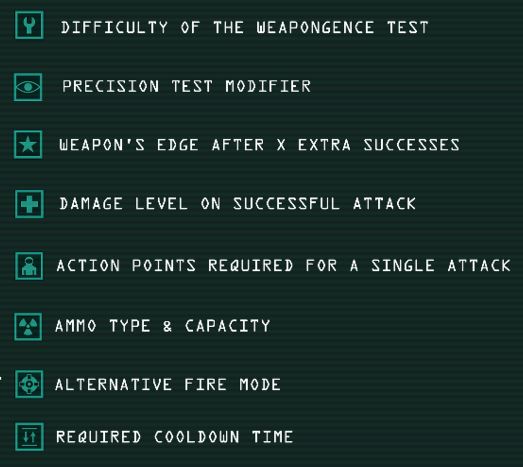
As it was stated many times before, each weapon has its constant Damage level, which can be changed only by the eventual armour of a target. However, if you can reach or exceed number of Extra Successes in Precision test required for enabling weapon’s Edge, you double the Damage level after hitting the target (indicating that you’ve aimed perfectly enough to hit enemy’s eye, armour joint etc.).
*
While choosing your range weapon, you should be mindful of its effectiveness on particular distance. Of course, a bullet reaching the target will do just as much damage within and outside its effective range, yet hitting the target in the first place becomes much, much more difficult (if not impossible) the further you have to aim.
| EFFECTIVE RANGE | DISTANCE IN METERS |
| ultra SHORT | <25m |
| SHORT | 25-50m |
| MEDIUM | 100-250m |
| LONG | 300-600m |
| ultra LONG | >800m |
As you can see, there are some gaps between ranges, allowing some common sense to be applied in different combat situations. That’s also a safety switch for arguing over 1 meter differences between ranges, as shooting over or under weapon’s effective range makes the difference (if it is technically possible in the first place – a Flamer or Plasmapistol will never allow for long range attack).
Whenever you try to hit the target below your weapon’s effective range (ex.: in short distance while shooting medium-range Autogun) you add +1 d6 die to your Precision test for each range level below your weapon’s dedicated one.
Whenever you try to hit the target over your weapon’s effective range (ex.: in medium distance while shooting a Shotgun) you subtract -1 d6 die from your Precision test for each range level below your weapon’s dedicated one.
***

An Autopistol is a hand-held, fully automatic Auto Weapon that fires solid-slug ballistic rounds at the intended target in rapid succession. The origin of Autopistols lay in Mankind’s past, in its precursors the ancient machine pistol and submachine gun, that date back to at least the late 2nd Millennium.
Small enough to be held and controlled in a single hand, these weapons are the favoured sidearm of many a warrior in the Imperium of Man, despite their lack of range and notoriously poor accuracy. Though poor at penetrating armour, its high rate of fire makes it useful against lightly armoured opponents.
*

An Autogun is an “extended” version of an Autopistol. Cheap, rugged and reliable, it can be found throughout the Imperium of Man, where it is appreciated for its decent damage and accuracy. Its main drawbacks are its weight and the need to carry a large amount of cumbersome ammunition for prolonged operations.
As a weapon, the Autogun is comparable in effectiveness to a Lasgun but lacks some of the Lasgun’s versatility, damage output and reliability. Autoguns are prone to jamming, especially in dusty and muddy conditions where intricate moving parts can quickly become fouled.
*

The Laspistol is the pistol version of the Lasgun and like that weapon fires a coherent beam of energetic photons that can burn through most materials. The Laspistol is powered by a miniature power pack that is usually placed within the grip. The Laspistol is capable of producing the same amount of damage in a skilled user’s hands as the Lasgun, yet it has drastically reduced range as compared to its variant rifle form.
The Laspistol lacks the Lasgun’s selective fire options, having only the ability to fire single shots. Despite its lack of killing power compared to the more potent weapons of the Imperial arsenal, the Laspistol remains the favourite sidearm of many soldiers, for it is rugged, solid, precise, requires very little maintenance, is not temperamental and will not overheat easily.
*

The Lasgun, also sometimes referred to as a Lasrifle, is a directed-energy antipersonnel weapon used by the military forces of the Imperium of Man and it is the most common and widely-used type of laser weapon in the galaxy. Though not as powerful as kinetic projectile weapons such as the ubiquitous Bolter, the lower cost of production, the lack of a requirement for ammunition production and resupply make the Lasgun the best choice for the large forces of the regular frontline troops, as well as Skitarii warriors of Adeptus Mechanicus.
Focused pinpoint laser beam is strong enough to take an ordinary human arm off with one shot but is not as effective against the more durable alien bodies and stronger types of personal armour. A Lasgun’s beam also cauterises the wounds it inflicts due to the immense heat given off by the shot. The Lasgun is effective when used en masse, but considerably less effective when used alone.
*

A Shotgun is an ancient ballistic weapon, which fires solid slugs that burst into submunitions to spread out over a wider area. Most soldiers that use Shotguns prefer the double-barrelled version and values its reliability even over the Lasgun when entering hostile drop zones.
The Adeptus Arbites also commonly use Shotguns for crowd control and urban conditions. On the other hand, Shotguns are also commonly used by criminal lowlifes in the lawless regions of most hive cities, where a large variety of specialist ammunition is used, including man-stopper rounds, modified bolt rounds and incendiary shells.
*

A Bolt Pistol is a smaller version of the Bolter in standard use by the Space Marines. Powerful and utilitarian side arms, Bolt Pistols have seen service within many of the Imperium’s military forces since its inception in the 30th Millennium. As a Bolt Weapon, the Bolt Pistol is favoured over the Laspistol due to its improved killing ability, although it is less reliable and generally holds fewer shots in its magazine than a Laspistol. It is able to fire either a single shot or a short, three-round burst with each pull of the trigger.
*
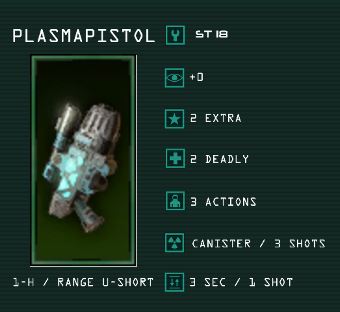
The Plasma Pistol is the smallest variant in the Plasma Weapons family. Each shot from a plasma pistol contains all the destructive fury of a larger Plasma Gun, although with a reduced range and rate of fire. The lethal might of the weapon is useful against both heavily armoured infantry and light armoured vehicles.
Even though they are prone to overheating and leaking energised plasma onto their unfortunate users, the devastating power of plasma weaponry made it too potent to abandon and nowadays it is still being upgraded by the Mechanicus. As the Great Crusade gains momentum, ever more potent armaments are pushing prototype plasma weapons to the battlefront more and more, regardless of the risks involved.
*

A Sniper Rifle is a high-powered and highly accurate projectile or directed energy weapon that is used to attack distant foes and lightly armoured targets at extreme ranges with unerring accuracy. Capable of firing powerful shots with lethal precision, sniper rifles can fell even the sturdiest enemy.
Very difficult to come by and even more difficult to operate with needed expertise, these weapons are granted only to the best of marksman within the imperial ranks. Combining accuracy with deadly, nearly unstoppable efficiency and stealth, so valued by all reconnaissance troops (Astartes and mortals alike), Small sniper teams or even lone snipers can stop advancing troops in their tracks, holding them up for hours while other military assets are called up to deal with them.
*
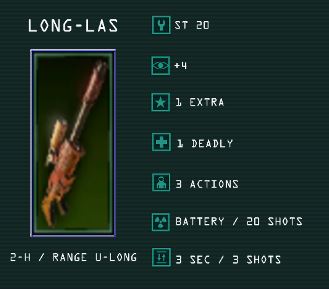
The Long-Las, originally known as the “Sniper Variant Lasgun,” is a specially modified version of the standard Lasgun constructed for increased range and accuracy.
Such weapons are only ever issued to those who have displayed a flair for marksmanship, stealth operations and scout movement, for such weapons are difficult to produce and require more training and intelligence to utilise properly.
Due to the increased power of the shot, the stress on the barrel is considerable and the resultant metal fatigue means that a sniper needs to replace the barrel with greater frequency than they would that of a standard pattern Lasgun.
*
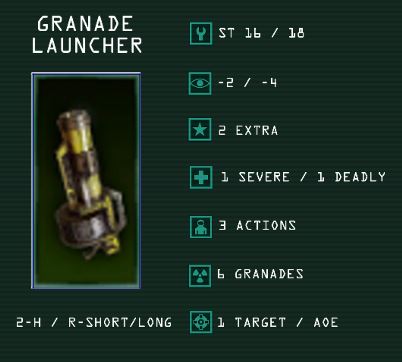
A Grenade Launcher serves the role of a launcher weapon that can be used and carried by a single un-augmented human. Unlike Missile Launchers, the explosive projectiles fired from a Grenade Launcher are not self-propelled, instead taking a ballistic trajectory once fired.
Grenade Launchers can fire a variety of grenade types but generally at a shorter range than other basic weapons due to the heavier nature of their payload. Unlike most weapons they can be fired in arcing shots designed to clear obstructions and strike farther into an enemy formation (AoE = 5m2) as well as simply being fired directly at foes.
*

Flamers are ideal for flushing out enemies in cover and putting groups of foes to the torch with projected flame. The two most common variants of Flamers either have a detachable fuel canister under the barrel, or a hose connecting to a backpack canister.
Flamer Weapons project fire upon their foes and generally use a fuel referred to as Promethium, though it can also be a home-made concoction or other chemical brew, depending on the local technology level. Most forms of Promethium are mono-propellant fuels that ignite via a smaller pilot flame at the tip of the barrel, though some Flamers use binary hypergolic fuels that ignite on contact with one another.
Once produced, the intense jet that spurts from the barrel creates a torrent of liquid fire, which spreads out in an inferno that burns even underwater, leaving enemies hard-pressed to put out the fire. It can also burst a cone of concentrated, incinerating cloud towards immediate vicinity of its welder, engulfing entire group of targets in flames (AoE +/- 5m2).
***
MELEE WEAPONS
For thousands and thousands of years blunt and sharp objects alike were used to cause pain, suffering and mortal wounds in close quarters combat. Even though primitive societies are seemingly long forgotten shadows of the ancient past, melee duels are still common during interstellar conquest. Brute force of muscles, ferocity and physical superiority are still as decisive for the war efforts of the Imperium, as Warp-technology or ingenuity of its Mechanicus allies.
Remember, that in melee or unarmed combat, each level of Success in test of Destruction adds 1 level of Damage (see table A) to target of your attack (see “Attack steps” section).
*

Unlike range weapons, melee ones do not require ammunition. Instead of this parameter, each weapon’s legend contains an icon of a shield, representing modifiers to blocking and parrying tests performed while defending enemy attacks with it.
***
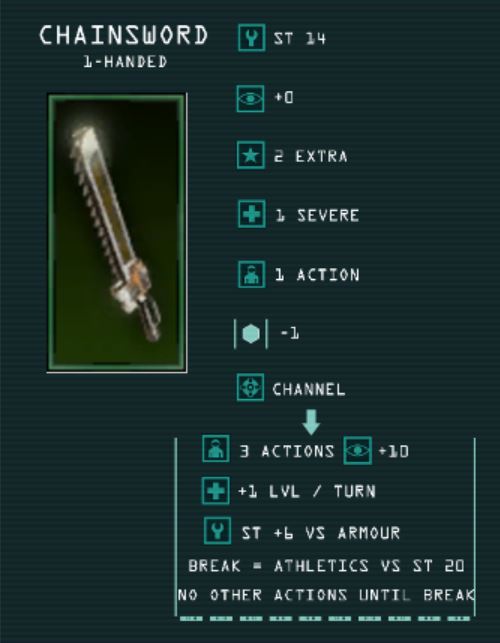
The chainsword is essentially a sword with powered teeth that run along a single-edged blade like that of a chainsaw. Most versions of the weapon make use of monomolecularly-edged or otherwise razor-sharp teeth. Chainswords are not subtle weapons, and wielding one is a statement in its own right: they are horrific tools of war, designed to bite, tear and eviscerate where more primitive blades merely cut and slice.
The weapon makes an angry buzzing sound as the teeth spin around, intensifying into a high pitched scream as they grind into armour. It is not unlike a real-world chainsaw, but lighter and able to be wielded with one hand. It is often used in conjunction with a Laspistol.
A chainsword brings the weight of intimidation with its obvious effectiveness, and it promises pain before death. On worlds claimed by Humanity, these blades are items of status for criminals and high-ranking gang fighters, as well as weapons of lethal (and crowd-pleasing) necessity for indentured gladiators.
*

A chainaxe is a brutal hand-to-hand chain weapon crafted in the form of a great one or two-handed axe which incorporates a powered chainsaw edge. The biting action of the whirling row of monomolecular teeth means these weapons can hack through both flesh and armour with ease.
During the start of the Great Crusade in the late 30th Millennium, the chainaxe was a standard close combat weapon used by the Legion Assault Squads of the Legiones Astartes, finding special favour amongst the Legionaries of the War Hounds. The XIIth Legion’s preference for close quarters fighting and dealing death face-to-face was demonstrated by the preponderance of close combat weaponry habitually carried by its rank and file.
Chainaxe is a weapon that dates back to the techno-barbarian tribes of Terra, the broad-bladed chainaxe. Such is the reputation it gained, particularly given its effectiveness against brutish xenos such as the Orks, that its use spreads to several of the other Astartes Legions.
*

A power sword is a weapon of varying lengths and designs, crafted from one of any number of different materials, though usually adamantium. Like a common sword, they allow the user greater attack options and defensive responses than many other melee weapons. Entire specialised styles of combat have been designed around the expansive number of variants found across the galaxy and beyond. Power weapons require great investments of time and rare materials to produce.
Therefore, power swords are typically reserved for high-ranking members of the Adeptus Astartes or other powerful and influential members of the Imperium, such as Astra Militarum officers. Elegant but effective, power swords allow the user greater attack options and defensive responses than many other varieties of power weapon. This efficient design makes them popular with officers regardless of whether they specialise in close combat or not.
Like all power weapons, a power sword projects a disruptive energy field along the blade of the weapon, allowing it to slice armour or strike with explosive impact. In theory, any weapon can be upgraded to a power weapon given the necessary technology, though in practice there is a traditional array in use by the Adeptus Astartes.
*

As with all Power Weapons, when its power field is activated, usually by operating a control located on the hilt, the Power Axe is sheathed in a lethal corona of disruptive energy. This energy field allows the blade to carve through flesh, bone and most forms of armour plate alike, making a Power Axe a highly effective close combat weapon.
The weight of a Power Axe allows for greater impact forces when striking compared to a Power Sword, but is consequently far less nimble in the hand. Their unwieldiness and inferior defensive capabilities are often mitigated by pairing them with a Combat Shield or other means of protection, allowing a warrior to stay his enemies’ attacks until he is ready to strike a killing blow. In most cases, they have a reputation as a brutal and unsubtle weapon; the choice to employ one is often more personal than strategic.
*
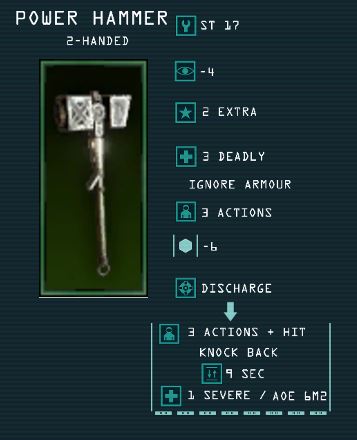
A Power Hammer is a simple tool used originally (just like Power Armours) for mining and construction activities on many Imperial worlds. The hammer can generate a low-quality molecular disruption field powerful enough to crack even ceramite.
Unsophisticated as it is, it does not require particular skill apart from sheer, immense strength to be even more devastating than the Power Axe on the battlefield. Overwhelming power granted by a single, heavy blow can often outweigh many limitations of the weapon, ignoring enemy armour and allowing its welder to attack multiple enemies with a powerful energy discharge.
Nevertheless, Power Hammers are practically useless in defensive combat, unless used by the inhumanly strong and specially trained warriors of the Legions. Seeing Power Axe as a compromise between brute force and masterful technique, one only chooses Power Hammer if the term “compromise” is not in their menu, erased by firm confidence in endurance and potential of one’s own muscles.
*
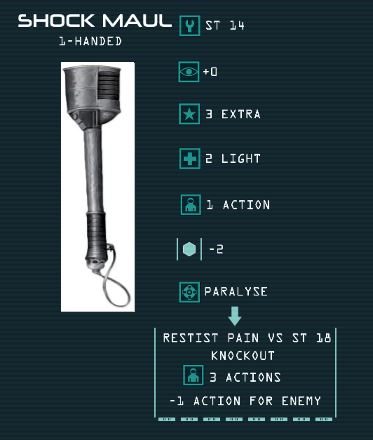
A Shock Maul, also called a Power Maul in its more lethal form, is a type of close combat weapon similar in shape to a mace or a club used by both the Adeptus Arbites and the Adeptus Astartes. Shock Weapons like the Shock Maul are designed to be generally non-lethal, assaulting the victim with incapacitating force through electrical shocks released on impact.
As Shock Weapons have little or no destructive impact on flesh other than minor electrical burn marks, they are useful for crowd control and “encouraging” workers such as shipboard press gangs or other forced labour.
A Shock Maul resembles a club surrounded in an electrical energy field which disrupts the surface of solid matter. The depth of the field can be adjusted to bash a hole through a wall or merely administer an irresistible knock-out blow to subdue a victim. The electrical energy that is discharged can cause severe burns on impact and can disrupt the nervous system.
A Power Maul is essentially the same weapon, save that it is surrounded in a power field like other Power Weapons whose primary purpose is to create molecular disruption that can be lethal in close combat.
***
ARMOUR
Various tools of destruction used by combatants in 31st Millenium would be considered an overkill if equally potent protective measures wouldn’t necessitate their existence. Not only re-conquered human colonies, lost to Terra during the Old Night, but also foul xenos use many unique types of armour, each with different strengths, weaknesses, technological advancement and cultural significance. Acquiring one is not merely a matter of individual wealth and availability of resources, just as overcoming their defences usually requires more than landing a single blow.
Some are unobtainable by anyone outside exclusive social circle (like hereditary armours of Imperial Knight Houses). Other are still early prototypes, designed for regular frontline infantry, elite veterans or special task forces, difficult to classify and reproduce. Anything, from the simplest bulletproof vest of Imperiallis Auxilia or hive-city law-enforcers to “Mark II” Power Armour of Adeptus Astartes can be effective in that critical moment of getting hit by deadly weapon.
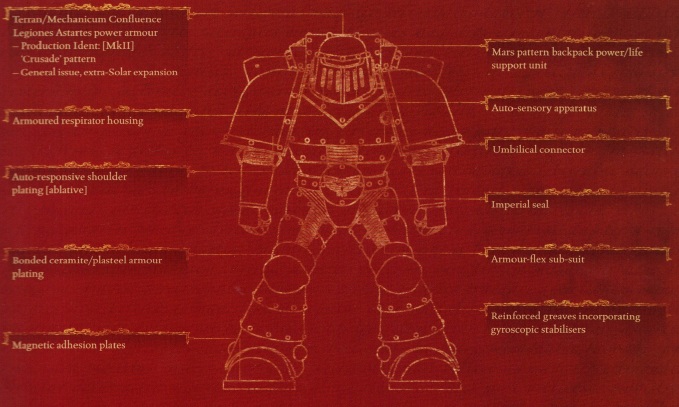
Enlisting them all would be equally impossible and pointless, especially from the perspective on unaugmented human, to whom many of these technological marvels will never be available. Thus much more general “templates” / classification of armour is presented below, to give the players general understanding of things most common, as well as to encourage them to making individual adjustments and upgrades, depending on their character’s progress, upgrading status within factions, winning renown, finding rare materials etc.

The first and foremost quality of an armour is, obviously, its ability to withstand the toll of battle. Soak parameter indicates the amount of damage you can ignore while wearing particular type of defensive suit. For example, no amount of Scratches done the the heavy breastplate of a power suit would cause it to loose integrity, even if done to exactly the same spot (at least in the battle conditions, not over the course of a 100 years). Threshold, on the other hand, shows what amount of punishment will be too much to absorb, causing destruction of protective material in a hit spot or the entire section struck by devastating blow.
In most cases protection granted by an armour isn’t full nor impervious. Anything excluded from that protection will be described as a Weak Spot, a hit to which ignores any qualities of the armour. In case of a simple vest anything but the corpus is a weak spot, while to hit one within a full battle suit one needs to aim perfectly into an arm or a leg joint, getting sufficient penalty to their Precision test.
Regarding usually considerable weight of that kind of equipment, manoeuvrability (all tests related to Speed) and number of Action Points of its wearer in combat can be diminished by it accordingly. Some types of armour are more or less resistant to specific type of damage, which is displayed as special quality. Those can be modified by proper adjustments and upgrades made by dedicated specialist, however only within limits of possibility the technology defines.
***

Simple as they are to design and manufacture, the most basic bulletproof vests are very common among Arbites, frontline infantry, better organised criminals or even more militaristic civilian societies. Not much has changed since the days of Old Earth, as vests are still best suited for stopping regular projectiles, offering limited protection against other types of weapon.
Relatively light and cheap as they are, vests do not require any specific skills nor physical traits to be used effectively. Then again, hardly any modifications are optional for this kind of armour, besides base differences on manufacturing level, granting higher defence quality against knives and non-power melee weapons at the cost of increased weigh, lesser manoeuvrability etc.
*

Even though much heavier than a simple vest, light armour is still available to regular human. The basic template of this protection type can vary significantly. From professional, partial body-armour, extended from original design of bulletproof chest-plate, to techno-barbaric amalgamation of various metal pieces, limb-covering plates made of kevlar or carapace, even to scraps of other, already damaged protective suits.
While still keeping its wearer far from invincibility, light armour offers the best trade-off between mobility and safety, granting some edge against many popular armaments on most galactic battlefields.
*
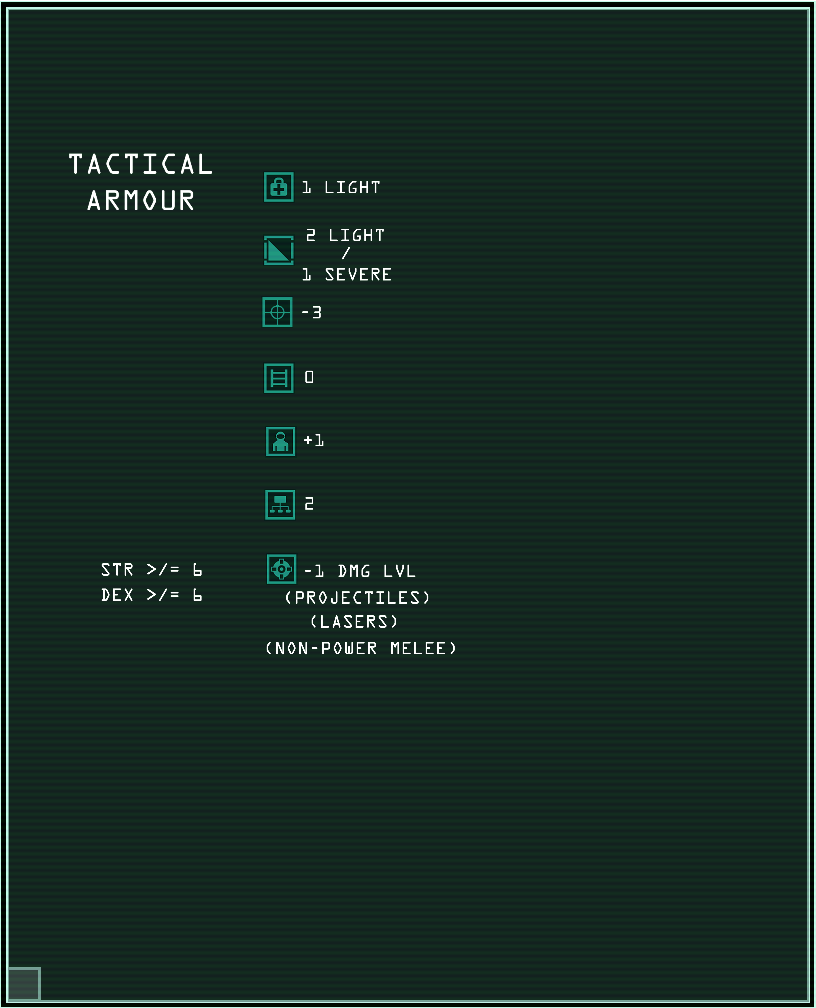
Designed specifically for specialised troops, like those involved in reconnaissance or any non-standard missions outside the main battlefield, tactical armours are constructed around individually suited exoskeleton, which supports one’s mobility instead of decreasing it like any other armour.
What makes tactical suits even more unique and harder to come by is their potential for modification, allowing for any adjustments required for particular mission, environment and combatant, like higher damage absorption, more complete body protection or even greater empowerment of soldier’s movements and manoeuvrability. Still, to exploit all the advantages this piece of technology provides, one needs to show some dexterity in the first place.
*
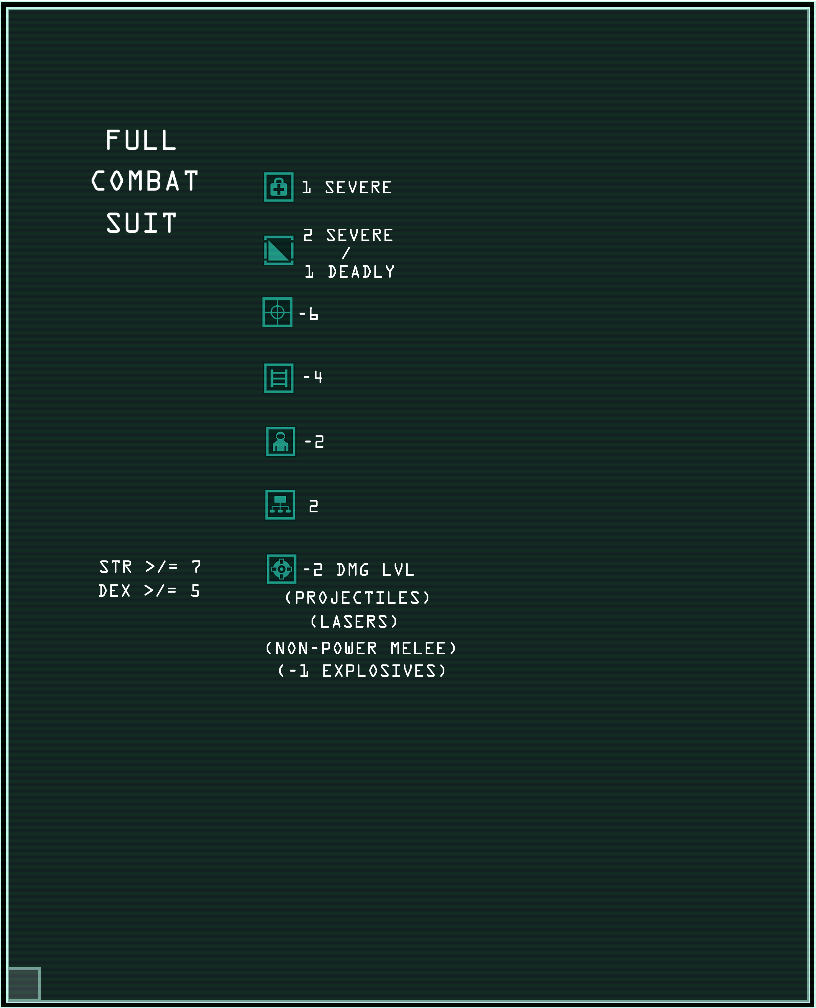
Being clad in metal from head to toes is probably as close to safety as anyone can gets while being shot at. Even more so if that metal (alongside any mixture of composites added to it) is highly resistant to anything but transhuman power-weapons, giving some resistance even against explosives.
Being partially death-proof (so to speak) comes at a cost that only few can pay. Enormous strength is required to maintain any combat-capacity and to be able to do anything but slowly moving forward. Luckily, high level of technological advancement allows for some useful modifications, should any elite (or extremely resourceful) warrior be able to obtain such an armour.
*

Unbeknown to most, the Imperium’s most prized and symbolic achievement – “Mark II” Power Armour of Adeptus Astartes – was originally designed as specialised heavy suit for imperial mine-workers, who had to operate in extremely deadly conditions to get to most crucial and unique resources. Destructive heat, pressure, poisonous gases, radioactive substances, weight of falling debry – all of those the environmental suit was designed to withstand.
Even in its original, pre-combat form, this type of extremely rare protective technology could be used only by individuals with nearly transhuman physique and specialist training for using power-tech.
***
 The Great Crusade